


A Calgary home inspection gives buyers valuable information about a property’s condition.
It can reveal visible problems with major systems and components. It can also help buyers understand repairs, maintenance needs, and areas that deserve more attention.
However, a home inspection is not the same as testing every possible part of a property.
Some concerns need special tools. Others need laboratory testing or a specialist.
Knowing the difference can help you make better decisions before buying a home.
What Does a Calgary Home Inspection Usually Do?
A professional home inspection is mainly a visual assessment of accessible areas and major home systems.
Depending on the property and inspection scope, an inspector may review areas such as:
- Roof and exterior
- Foundation
- Basement
- Attic
- Plumbing
- Electrical systems
- Heating and cooling equipment
- Windows and doors
- Insulation
- Ventilation
- Interior spaces
- Drainage and grading
The goal is to identify visible conditions that may affect the property’s safety, function, or maintenance.
That information can be extremely useful during a home purchase.
Still, buyers should understand that some conditions cannot be confirmed through a standard visual inspection.
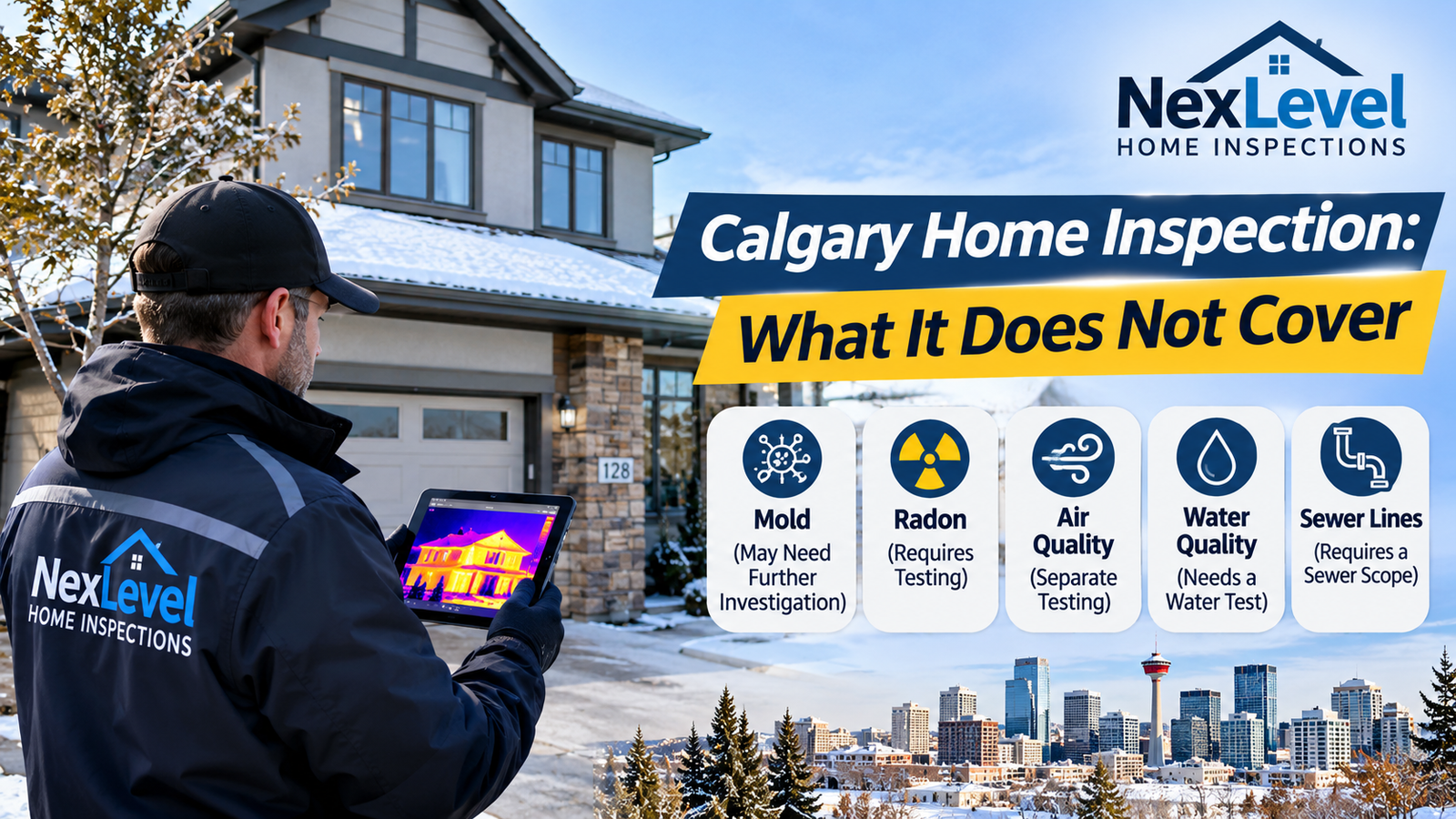
1. A Home Inspection Does Not Replace Specialist Testing
Some property concerns require dedicated testing.
For example, you may want specific testing for radon, water quality, indoor air quality, or carbon monoxide.
These tests answer different questions.
A visual inspection can identify signs that deserve further attention. Testing can provide measurements or laboratory results when appropriate.
This distinction matters.
A clean-looking room does not automatically mean the air or water is free from every possible contaminant.
2. Mold May Need Further Investigation
An inspector may notice visible mold or conditions that could support mold growth.
However, hidden mold is a different issue.
Mold can exist behind finished walls, under flooring, or in other areas that are not accessible during a normal inspection.
If there are strong odors, visible growth, past water damage, or ongoing moisture concerns, further investigation may be appropriate.
The first question should always be:
Where is the moisture coming from?
Finding and controlling the moisture source is an important part of addressing a recurring mold problem.
3. Radon Requires Testing
Radon is an invisible gas.
You cannot reliably determine the radon level in a home by looking at walls, floors, or mechanical systems.
A dedicated radon test is needed to measure the concentration over the required testing period.
This can be especially relevant for homes with basements or lower-level living areas.
If you are concerned about radon, ask about a dedicated test rather than assuming a normal home inspection answers the question.
4. Air Quality Is a Separate Question
Indoor air can contain different particles or pollutants.
A standard visual inspection may identify possible sources of concern, but it does not automatically provide a complete indoor air quality assessment.
Air quality testing can be considered when there are concerns about:
- Unusual odors
- Persistent dust
- Smoke
- Allergens
- Poor ventilation
- Renovation-related concerns
- Suspected indoor pollutants
Testing should match the concern.
There is no single test that answers every indoor air quality question.
5. Water Quality May Need Its Own Test
A home inspection can examine visible plumbing components.
That does not mean the water itself has been tested.
If a property uses a private water source, has unusual water appearance or taste, or has another specific concern, dedicated water testing may provide useful information.
The inspection and the water test serve different purposes.
One evaluates the visible plumbing system.
The other evaluates the water sample.
6. Underground Sewer Problems Can Stay Hidden
Your home’s sewer line is underground.
An inspector cannot see the entire line simply by looking at fixtures or running water.
A sewer scope uses a camera to examine the inside of the accessible sewer line.
This can reveal problems such as:
- Root intrusion
- Cracks
- Blockages
- Separation
- Pipe damage
- Standing water
- Other visible defects
A sewer scope can therefore provide information that a normal visual inspection cannot.
This can be particularly useful when buying an older property.
7. A Home Inspection Does Not Predict Every Future Repair
A home inspection describes conditions observed at the time of the inspection.
It cannot predict every future failure.
A furnace may operate during the inspection and fail later.
A roof may appear serviceable but still require replacement in the future.
A plumbing component may work normally and develop a problem months later.
That is why inspection reports should be viewed as a snapshot of the property’s condition, not a guarantee that nothing will ever fail.
8. Hidden Areas May Have Limited Inspection Access
Inspectors cannot inspect what they cannot safely access.
Furniture, stored belongings, finished walls, locked areas, snow, landscaping, or other obstacles may limit visibility.
Some components are also concealed by construction.
For example, electrical wiring inside a finished wall cannot always be fully evaluated without opening the wall.
The same principle applies to plumbing, insulation, structural framing, and other concealed components.
9. Cosmetic Issues Are Not the Main Purpose
Buyers sometimes expect an inspection to identify every scratch, paint mark, dent, or minor cosmetic defect.
That is not the main purpose.
The bigger goal is understanding the condition of important systems and components.
A small wall mark may not matter much.
A water stain behind that wall could matter a great deal.
A good inspection helps buyers focus on the issues that can affect safety, function, maintenance, and ownership costs.
What Should Buyers Do After the Inspection?
Read the report carefully.
Make a list of the findings that need attention.
Then separate them into three groups:
Immediate Concerns
These may include safety hazards, active water entry, major structural concerns, or other conditions that require prompt attention.
Near-Term Repairs
These are issues that may not require immediate action but should be planned for.
Maintenance Items
These are normal upkeep tasks that can help protect the property over time.
If a report identifies something outside the inspector’s scope, ask what type of specialist or additional test may help.
Should You Get Additional Testing?
Additional testing should be based on the property and your concerns.
For example, a buyer may consider:
- Radon testing
- Water testing
- Air quality testing
- Carbon monoxide testing
- Sewer scope inspection
- Specialist structural assessment
- Further evaluation of suspected moisture or mold
You do not necessarily need every test for every property.
The smart approach is to identify the specific risk and choose the right test for that risk.
Why Understanding Inspection Limits Matters
A home inspection is most useful when buyers understand what the report can tell them.
It can help reveal visible defects and conditions that deserve attention.
It can also point to areas where further testing may be useful.
That gives buyers a clearer picture before they make one of the biggest financial decisions of their lives.
Final Thoughts
A Calgary home inspection is an important part of the home-buying process.
However, it should not be treated as a test for everything inside and outside a property.
Some concerns require dedicated testing.
Others need specialist evaluation.
The best approach is simple: understand the inspection scope, read the findings carefully, and investigate important concerns before making your final decision.
If you are buying a home in Calgary or surrounding communities, a professional inspection can give you useful information about the property’s current condition and help you decide what questions need further investigation.
Contact NexLevel Home Inspections
Phone: (403) 633-6616
Alternate: (587) 830-0840
Email: nexlevelinspections@gmail.com
Website: www.nexlevelinspections.com
Service Areas: Calgary, Cochrane, Airdrie, Chestermere, Conrich, Okotoks, High River











Leave a Reply