



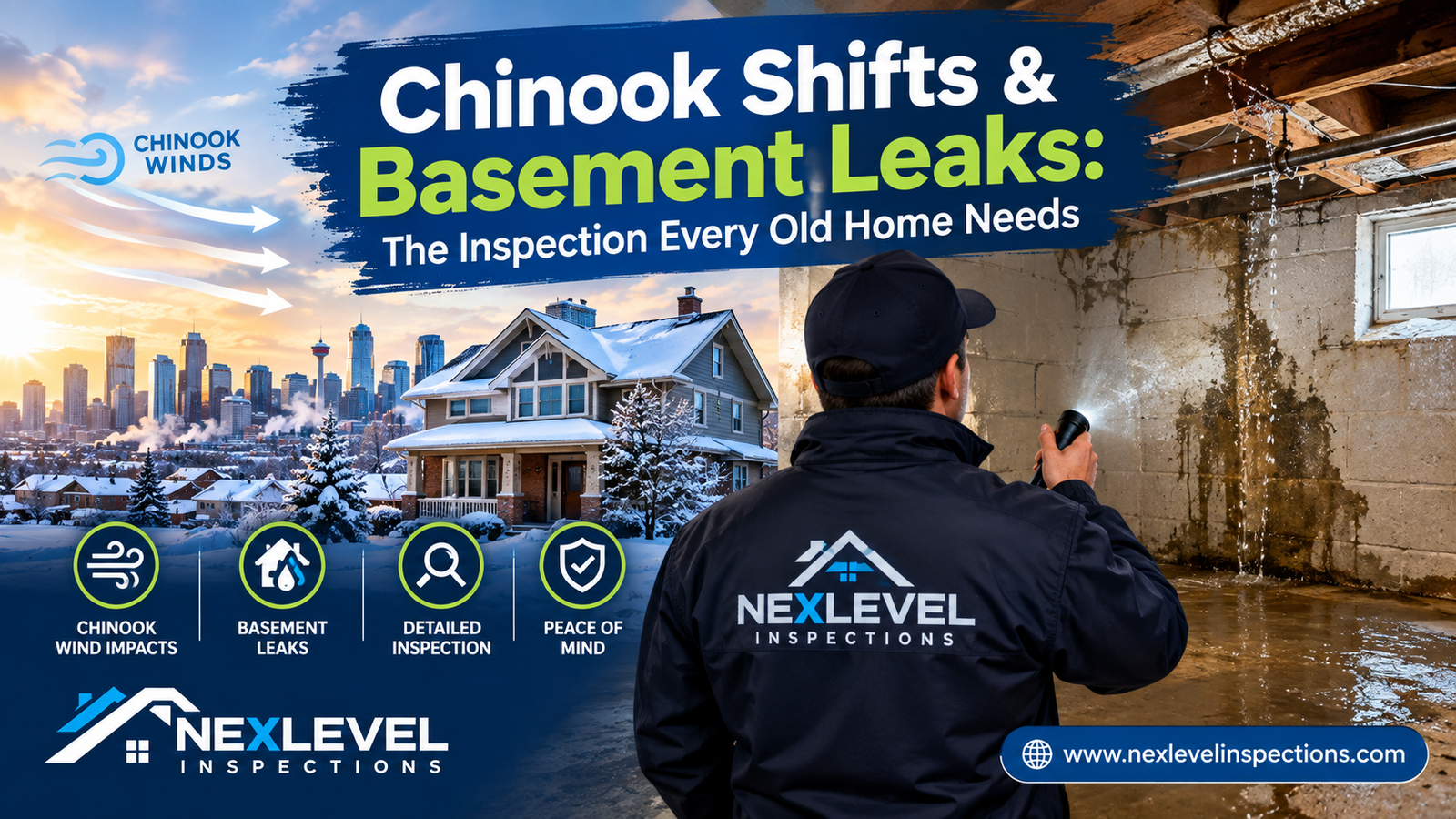
Calgary’s famous Chinook winds are a welcome relief in the dead of winter. In just a few hours, warm air sweeps off the Rockies, sending temperatures soaring from -20°C up to +10°C.
However, while residents celebrate the sudden warmth, older Calgary homes take a severe beating during every single Chinook shift.
When feet of snow melt in a matter of hours while the ground deep below remains frozen solid, meltwater has nowhere to go. Consequently, immense hydrostatic pressure builds up directly against aging concrete foundations. If your home was built between the 1950s and 1980s, these rapid freeze-thaw cycles frequently lead to hidden basement water intrusion, structural foundation movement, and concealed mold growth.
At NexLevel Home Inspections, certified inspectors Pritpal Singh, Navpreet Singh, and Jason use high-resolution thermal imaging and deep moisture diagnostics to uncover winter water intrusion. Here is why an older home inspection targeting Chinook-related vulnerabilities is essential for every homeowner and buyer in Calgary.
1. The Science of the “Chinook Squeeze” on Older Basements
To understand why older basements fail during a Chinook, you have to look beneath the snowline:
-
The Frozen Sub-Soil Barrier: Calgary’s frost line often sinks several feet into the ground. During a sudden mid-winter thaw, the top couple of inches of soil thaw into slush, while the sub-soil stays rock-hard.
-
The Hydrostatic Trap: Because water cannot soak naturally into frozen sub-grade soil, it pools against the exterior of your foundation wall.
-
Thermal Expansion & Contraction: Rapid 20-degree temperature swings cause foundation concrete and mortar joints to expand and contract quickly. As a result, older, brittle concrete develops micro-fissures that allow high-pressure groundwater to force its way inside.
2. Why Older Calgary Homes Are at the Highest Risk
Modern homes benefit from weeping tiles, damp-proofing spray, and heavy dimpled drainage membranes (delta wraps). Older character homes throughout established Calgary neighborhoods often lack these modern water barriers:
-
Aged or Crushed Weeping Tile: Homes built before 1980 frequently have clay tile or tar-paper weeping systems. Over decades, these pipes collapse, silt up, or clog with tree roots, leaving zero relief for rising water tables.
-
Degraded Exterior Tar Coating: The original bituminous damp-proofing applied to older concrete becomes brittle and flakes away after 30 to 40 years, allowing water to wick through bare concrete pores.
-
Settled Perimeter Grading: Over decades, flower beds and natural soil settling create negative slopes that guide melting snow straight into window wells and foundation walls. Learn why downspouts and soil grading are your first line of defense.
3. The 4 Critical Warning Signs Caught During a Chinook Inspection
Many homeowners assume a dry basement floor means their foundation is safe. In reality, water intrusion often remains trapped inside insulation layers long before puddles reach the concrete floor.
-
Concealed Moisture Behind Finished Drywall: Finished basement rec rooms hide damp concrete until black mold takes hold. We deploy infrared cameras to detect cold evaporation signatures through sheetrock without cutting holes. Discover why finished basements require expert inspection eyes.
-
Efflorescence and Mineral Leaching: White, powdery mineral deposits along exposed concrete indicate that water is evaporating out of the wall, leaving damaging salts behind.
-
Horizontal and Diagonal Shear Cracks: Unlike minor vertical shrinkage lines, diagonal or stair-step cracks indicate that lateral freeze-thaw ground pressure is pushing the wall inward. Review our complete basement inspection checklist from sump pumps to foundation cracks.
-
Sump Basin Overload & Frozen Discharge Lines: If your sump pump runs continuously during a Chinook, or if the exterior discharge line freezes solid overnight when temperatures drop back below zero, total pump burnout and basement flooding occur rapidly.
Modern vs. Older Basement Defense During a Chinook
| Foundation Component | Modern Calgary Build (Post-2010) | Older Calgary Home (Pre-1990) |
| Waterproofing Membrane | Dimpled exterior air-gap drainage wrap | Thin asphalt/tar damp-proofing (often degraded) |
| Weeping Tile Drainage | Perforated PVC wrapped in geotextile fabric | Clay pipes or tar-paper weeping lines (often blocked) |
| Sump Pit & Pump | Dedicated sealed sump basin with check valve | Often missing, unsealed, or connected directly to sewer lines |
| Wall Construction | Poured concrete with steel rebar reinforcement | Unreinforced concrete or mortar-set cinder blocks |
| Primary Failure Risk | Surface downspout disconnects | Structural wall shear cracking & sub-grade seepage |
4. Stop a $20,000 Water Disaster Before It Starts
Ignoring sub-grade water intrusion after a major winter thaw can quickly result in catastrophic structural repair bills and severe air quality hazards.
-
Avoid Sub-Grade Repair Bills: Early diagnosis of failing perimeter drainage saves tens of thousands in excavation costs. See how easily a basement can hide a $20K problem.
-
Protect Older Infrastructure: Older properties frequently combine basement moisture vulnerabilities with outdated utility setups. Check our guide on hidden electrical and plumbing risks in older homes.
-
Preserve Healthy Living Spaces: Trapped sub-grade dampness rapidly migrates through floor cavities into living areas. Learn how attic and basement inspections protect indoor air quality.
-
Secure Buyer Leverage: If you are purchasing an older home, use your inspection findings to request repair allowances before waiving conditions. Discover how to use home inspection findings to negotiate like a pro.
Calgary Inspector Insight: “A Chinook reveals the true mechanical and structural stamina of an older home,” says Pritpal Singh. “If a foundation has drainage or grading flaws, our thermal diagnostic tools will catch the moisture signature the moment the snow begins to melt.”
Inspect Your Older Home with NexLevel Precision
Don’t wait for a sudden thaw to turn your basement into a water hazard. Let Pritpal Singh, Navpreet Singh, and Jason at NexLevel Home Inspections evaluate your foundation, mechanical drainage, and moisture barriers with complete diagnostic accuracy.
🏆 Partner with Calgary’s Premier Home Inspection Team
-
Book Online 24/7: www.nexlevelinspections.com
-
Call/Text Us Directly: (403) 633-6616 | (587) 830-0840











Leave a Reply