



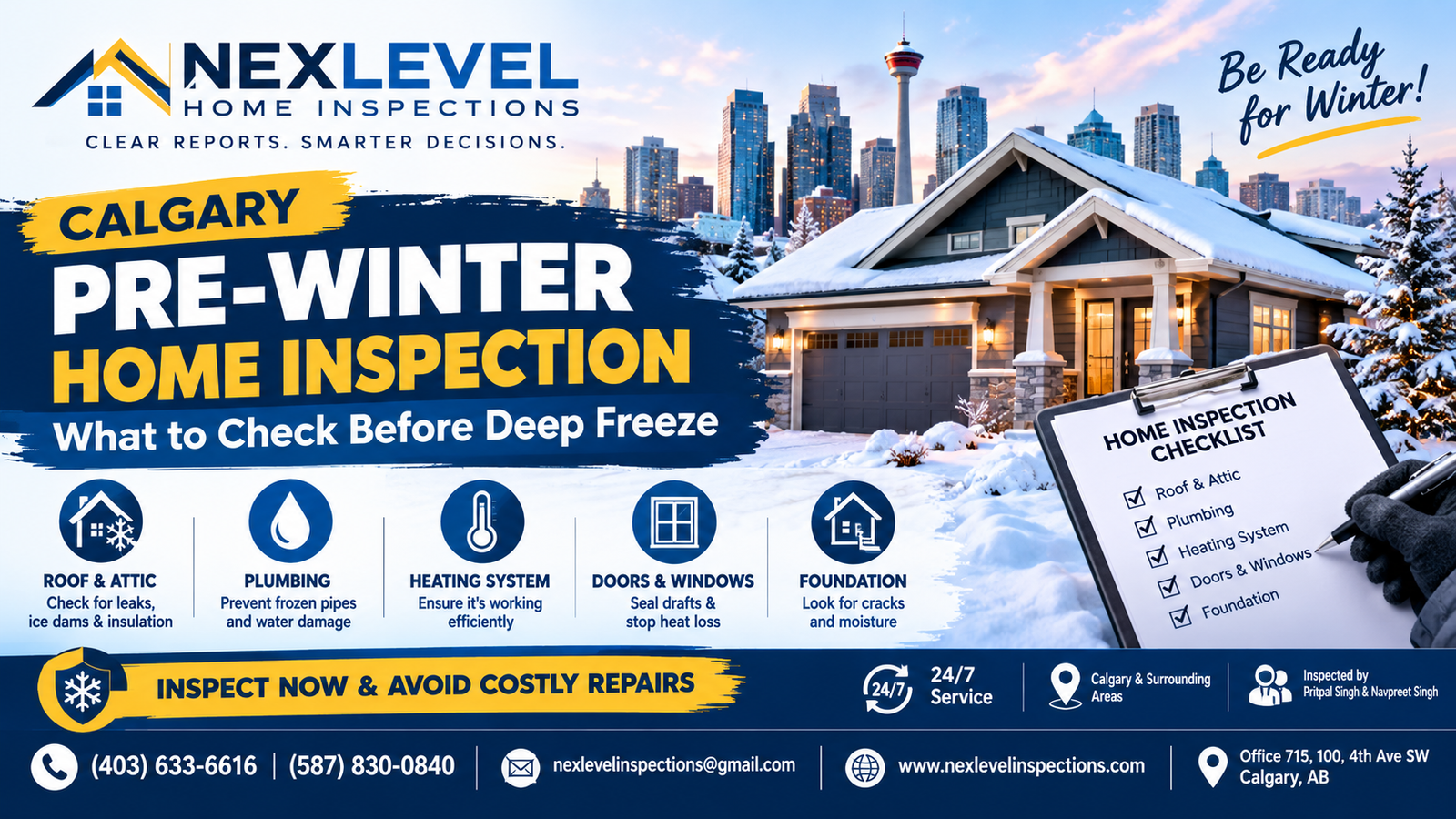
Calgary winters do not arrive gently. In a matter of days, crisp autumn afternoons can plunge into sustained sub-zero conditions, bringing -30°C wind chills, heavy snowfall, and deep ground frost.
When severe cold sets in, your home becomes a pressurized thermal envelope. Indoor heating battles frigid exterior drafts, plumbing lines in exterior walls face freezing risks, and unsealed attic penetrations start collecting hidden frost. Waiting until your furnace stalls or water drips through a ceiling light fixture in mid-January means dealing with emergency service rates and severe structural headaches.
At NexLevel Home Inspections, certified inspectors Pritpal Singh, Navpreet Singh, and Jason help homeowners fortify their properties before the frost line locks in. Here is the definitive pre-winter inspection checklist to ensure your home survives Calgary’s harshest weather.
1. Attics & Building Envelopes: Preventing “Attic Rain”
Attic rain is one of Calgary’s most destructive cold-weather phenomena. It occurs when warm, moist air from your living space escapes into a freezing attic, coats the underside of the roof sheathing in frost, and suddenly melts during a warm Chinook.
Before the first deep freeze, verify your upper building envelope defenses:
-
Vapor Barrier Seals & Access Hatches: Check that attic hatch lids are weather-stripped and insulated. Unsealed hatches act as open chimneys for warm air.
-
Exhaust Duct Discharge: Ensure bathroom fan ducts and dryer vents vent completely to the exterior through dedicated roof or wall caps, rather than terminating inside the attic cavity. Discover how attic and basement inspections protect indoor air quality.
-
Soffit Baffle Clearances: Confirm insulation has not drifted over perimeter soffit vents, keeping continuous cold airflow moving across the roof deck to prevent ice damming.
2. Heating & Ventilation: Testing Under Full Load
Your furnace and ventilation systems cannot afford to fail during a sub-zero cold snap. Testing operation before peak demand prevents mid-winter shutoffs.
-
Heat Exchanger & Flame Sensor Health: Inspect burners for clean combustion and verify that flame sensors are free of carbon buildup that triggers sudden shutdowns.
-
HRV / ERV Balancing & Filter Care: Clean the core and foam pre-filters on your Heat Recovery Ventilator. Ensure the outdoor intake and exhaust hoods are clear of leaves and debris.
-
Thermostat Calibration & Filter Replacements: Replace standard 1-inch to 4-inch furnace filters to maintain proper static airflow and avoid blower motor burnout. Review our guide on what a full Calgary home inspection covers to understand comprehensive mechanical reviews.
3. Exterior Plumbing & Hose Bibbs: Preventing Burst Lines
Water expands by approximately 9% when it freezes, creating thousands of pounds of pressure inside copper and PEX plumbing lines.
-
Disconnect Exterior Garden Hoses: Leaving a hose attached to a frost-free hose bibb traps water inside the sillcock valve barrel inside your rim joist. When it freezes, the copper tube bursts, causing indoor flooding the moment the valve is turned on next spring.
-
Shut Off & Drain Interior Isolation Valves: Close interior shutoff valves supplying exterior spigots and open the bleeder cap to drain residual line moisture completely.
-
Inspect Sump Pump Discharge Lines: Verify that the exterior flexible hose attached to your sump pump discharge pipe is disconnected before freezing temperatures arrive. If that hose freezes solid, the sump pump will burn out trying to push water against ice, flooding the basement. Follow our basement inspection checklist from sump pumps to foundation cracks.
4. Foundations, Soil Grading & Downspouts
Once the soil freezes several feet deep, water drainage around your foundation footings becomes locked in place until spring melt.
-
Extend Downspouts Beyond Backfill: Ensure all downspout extensions discharge water at least six feet away from foundation walls to prevent frost heaving and foundation cracking. Learn why downspouts and soil grading are your first line of defense.
-
Clean Gutters and Eavestroughs: Clear out all deciduous leaves and roof grit. Clogged gutters trap standing water, expand into heavy ice dams, and pull gutter brackets out of fascia boards.
-
Seal Exterior Masonry & Siding Penetrations: Caulk exterior gaps around gas lines, electrical conduits, and water pipes to prevent cold wind washing into basement rim joists. Discover how Chinook shifts trigger older basement leaks.
Pre-Winter Checklist: Component Risk vs. Preventive Action
| Inspection Area | Cold-Weather Hazard | Pre-Freeze Action Required |
| Attic Space | Warm air bypass creating attic frost & “attic rain” | Check hatch seals, duct connections, & soffit airflow |
| Exterior Hose Bibbs | Trapped line water freezing & bursting copper pipes | Disconnect hoses & drain interior shutoff valves |
| Sump Pump Line | Frozen exterior line causing pump burnout & flooding | Remove flexible seasonal extension hoses |
| Furnace / Heating | Cracked heat exchangers or blocked burner sensors | Complete combustion test & replace air filters |
| Roof & Gutters | Ice dams forcing meltwater under shingles | Clear eavestroughs & check valley flashing integrity |
5. Infrared Thermal Imaging: The Secret to Stopping Heat Loss
You cannot fix heat loss you cannot see. Standard visual checks cannot identify missing insulation batt sections or air leakage around window framing.
NexLevel’s high-resolution infrared thermal imaging scans reveal:
-
Concealed Insulation Voids: Pinpoints gaps inside exterior walls and upper ceiling borders where cold drafts penetrate.
-
Drafty Door & Window Seals: Shows failing weatherstripping around exterior doorways before your heating bill doubles.
-
Basement Rim Joist Air Infiltration: Detects freezing outdoor air entering uninsulated foundation header cavities. Learn why finished basements require expert inspection eyes to avoid a hidden $20,000 basement disaster.
Plan Ahead Before Winter Surprises Strike
Taking defensive action before winter sets in safeguards your home’s equity, preserves indoor comfort, and avoids emergency service calls.
-
Buying an Older Property? Check our guide on hidden electrical and plumbing risks in older homes.
-
Moving into a New Build? Ensure builder trades properly sealed the thermal envelope before possession. Discover why you should never assume a new build is perfect.
-
Evaluate Pricing: Understand how comprehensive assessments fit your maintenance plan by checking how much a Calgary home inspection costs.
Calgary Inspector Insight: “A deep freeze acts as a stress test for every mechanical and thermal system in your home,” notes Jason. “A pre-winter thermal inspection catches air gaps, insulation voids, and plumbing risks while they can still be resolved easily.”
Winterize Your Home with NexLevel Precision
Don’t wait for the first sub-zero deep freeze to reveal where your home is vulnerable. Let Pritpal Singh, Navpreet Singh, and Jason at NexLevel Home Inspections deliver the thermal diagnostic clarity and structural guidance you need to keep your home protected all winter long.
🏆 Partner with Calgary’s Premier Home Inspection Team
-
Book Online 24/7: www.nexlevelinspections.com
-
Call/Text Us Directly: (403) 633-6616 | (587) 830-0840










Leave a Reply